Direct answer
YIG is yttrium iron garnet, a synthetic ferrimagnetic crystal with the chemical formula Y₃Fe₅O₁₂. A small YIG sphere placed in a DC magnetic field resonates at a frequency proportional to that field. Because the resonant frequency follows the applied field rather than a fixed physical dimension, one YIG resonator can be tuned across an octave or more — which is why YIG appears in wideband microwave oscillators, filters and preselectors where a fixed-tuned cavity cannot reach.
Key takeaways
- A YIG resonator is tuned by a magnetic field, not by changing a physical dimension.
- That is what buys multi-octave tuning from a single device.
- YIG has an exceptionally narrow ferrimagnetic resonance linewidth, which is the source of its high Q.
- The tuning magnet, not the crystal, sets settling time and power consumption.
Most microwave resonators are tuned by geometry. A cavity resonates at a frequency set by its dimensions, and a dielectric resonator by the size and permittivity of its puck. To move the frequency, something physical has to move, or the part has to be replaced.
A YIG resonator does not work that way. It tunes by magnetic field rather than by geometry, which is the whole reason it exists in a signal chain and the premise behind the rest of the YIG technology guides.
The material
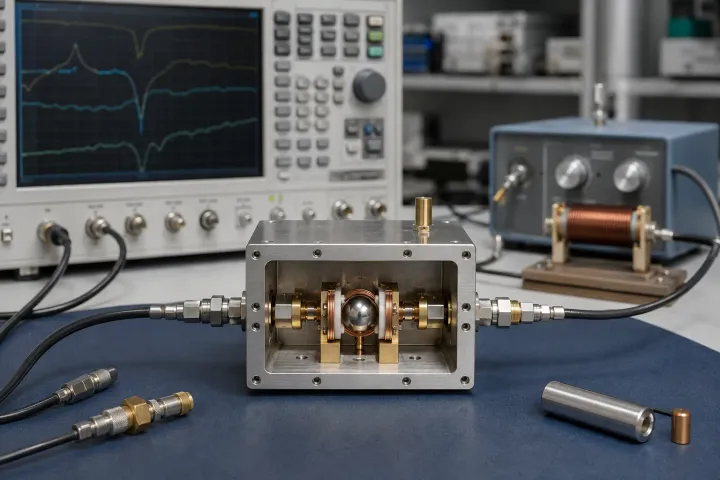
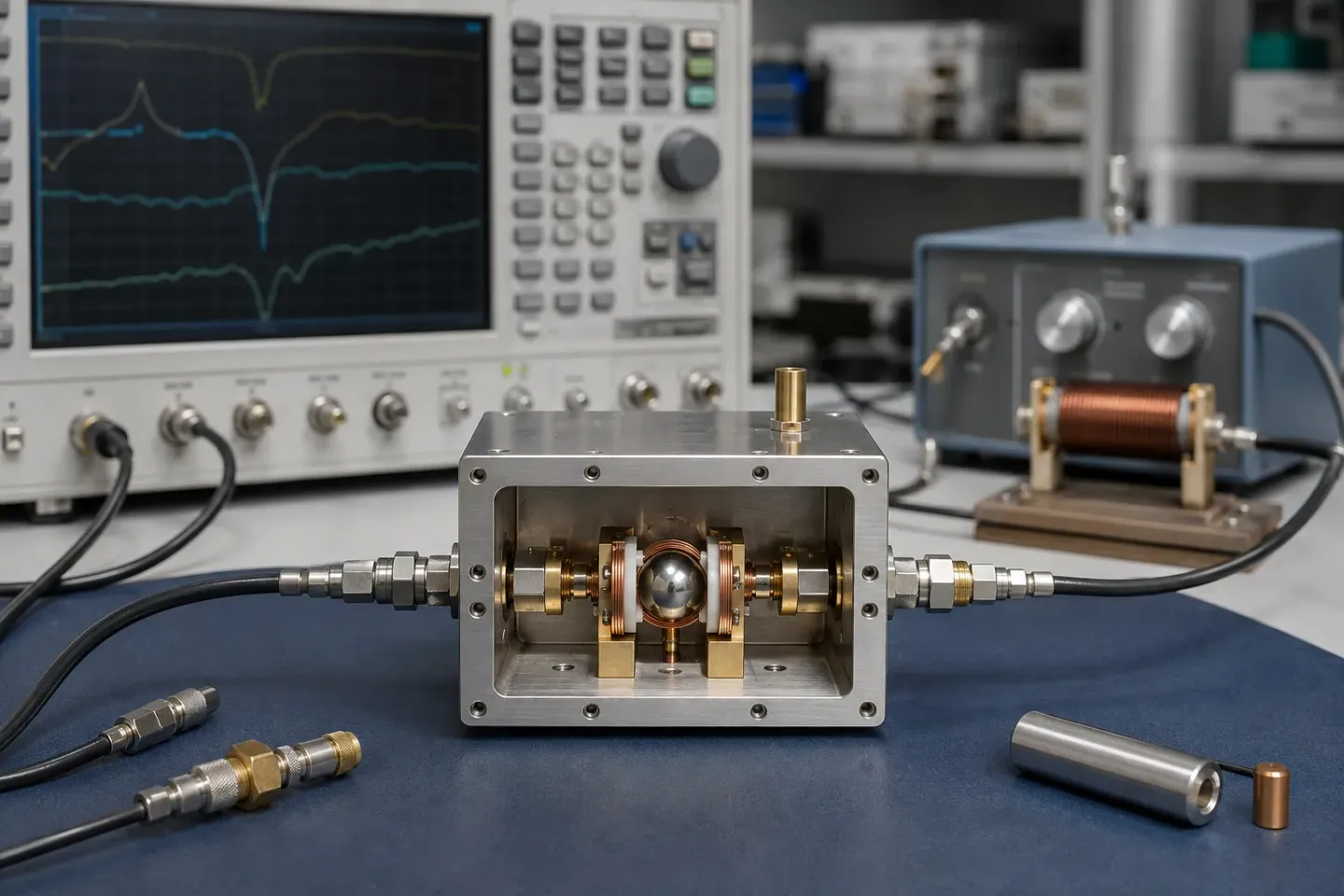
Yttrium iron garnet is a synthetic ferrimagnetic crystal, Y₃Fe₅O₁₂, and it is an electrical insulator. In a microwave device it is usually a polished sphere well under a millimetre across, held on a small rod inside a coupling loop.
Two properties matter. First, the crystal has an exceptionally narrow ferrimagnetic resonance linewidth — narrower than other practical ferrites — and that narrow linewidth is what gives a YIG resonator its high unloaded Q. Second, it is an insulator, so it does not carry the eddy-current losses that a conducting magnetic material would at microwave frequencies.
The tuning mechanism
Place the sphere in a DC magnetic field and the electron spins precess about the field direction. The precession frequency is proportional to the strength of that field. Drive the coupling loop at that frequency and energy couples strongly into the sphere; drive it away from that frequency and it does not.
The consequence is the useful part. The resonant frequency tracks the applied magnetic field, and nothing physical has to move. Change the current in an electromagnet and the resonance moves with it, smoothly and repeatably, across a range no fixed-geometry resonator can cover.
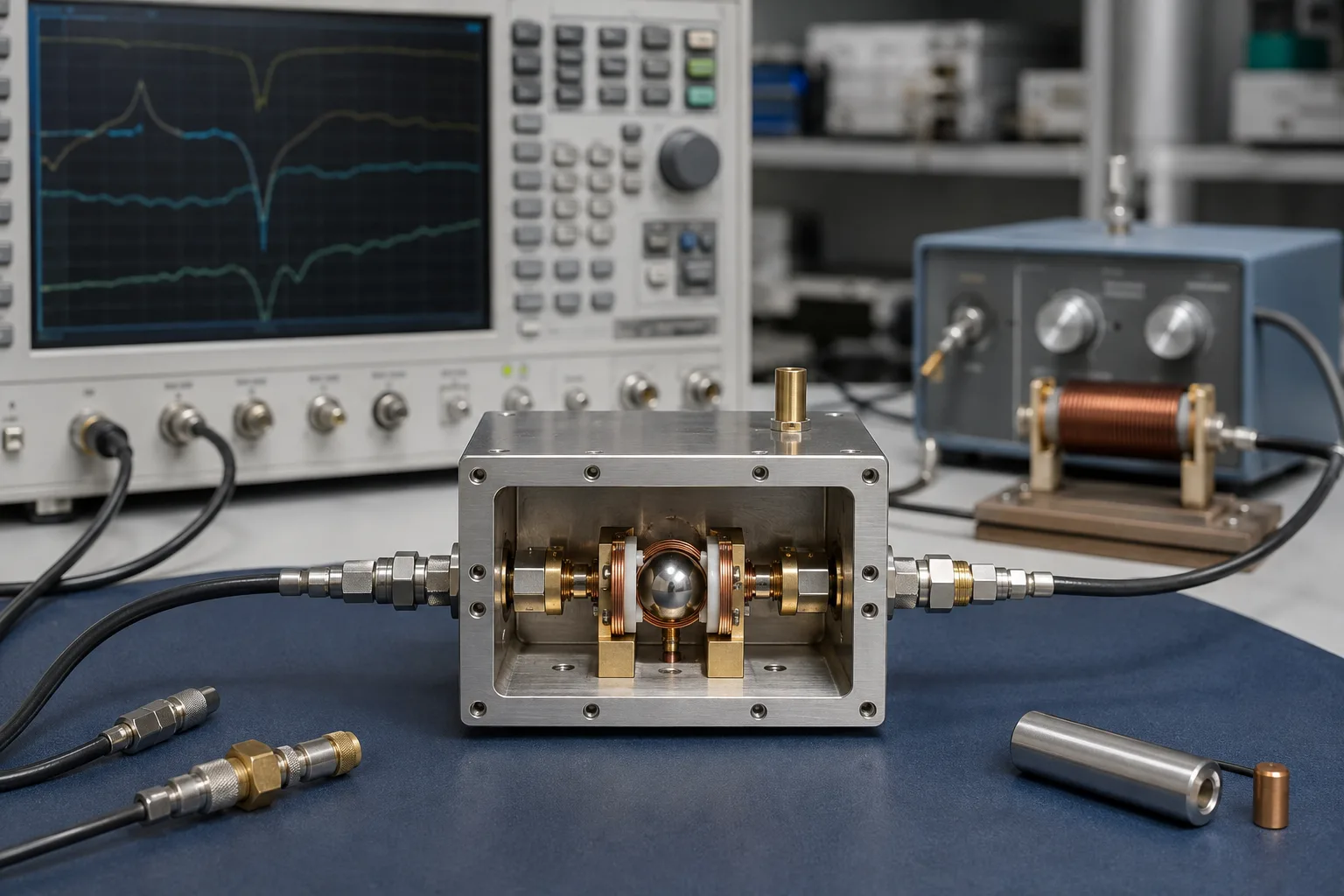
That is why a single YIG-tuned oscillator can be specified over ranges like 2–8 GHz or 8–18 GHz, and why commercial parts collectively cover roughly 700 MHz to 40 GHz.
The linearity matters as much as the range. Because the resonance follows the field directly rather than through some non-linear device characteristic, frequency versus tuning current is close to a straight line across the whole band. A varactor-tuned oscillator’s frequency-versus-voltage curve is markedly non-linear, which pushes complexity into the control loop. With YIG, that complexity mostly disappears — which is why sweepers and wideband receivers reached for it long before cheaper alternatives existed.
What the magnet costs you
The crystal is the elegant part. The magnet is where the engineering compromises live.
The tuning field comes from an electromagnet coil, and that coil has inductance. Changing the field means changing the current, and changing the current takes time — so a YIG device’s tuning speed is set by the magnetic circuit and its driver, not by the resonator. The coil also dissipates power continuously to hold a frequency, and it makes the device sensitive to external magnetic fields and to its own thermal history.
If you are comparing a YIG source against a VCO, this is the trade you are actually making: exceptional tuning range and spectral purity, paid for in settling time, power and package size.
Why a sphere, and why polished
The shape is not incidental. A sphere has no preferred demagnetising axis, so its resonance depends on the applied field rather than on how the part happens to sit in its holder. Any other shape makes orientation a variable you would have to control and calibrate.
Surface finish matters for the same reason Q matters. Scattering at surface imperfections broadens the resonance, and a broadened resonance is a lower-Q resonance. YIG spheres are therefore lapped and polished to a degree that has more in common with optics than with ordinary machining, which is a significant part of why YIG components cost what they do.
What it is not good at
| Property | Consequence | Why |
|---|---|---|
| Tuning range | Octave or more from one device | Frequency follows the field, not a dimension |
| Tuning linearity | Close to a straight line | No non-linear device characteristic in the path |
| Unloaded Q | High | Exceptionally narrow ferrimagnetic resonance linewidth |
| Tuning speed | Slow — milliseconds for wide steps | The tuning coil is inductive |
| Standby power | Continuous | Holding a frequency means holding a coil current |
| Size | Large | The magnet, not the crystal, sets the package |
| Magnetic immunity | Poor | The control variable is a magnetic field |
Qualitative comparison of the device class against fixed-geometry resonators. For values, work from a specific part's datasheet.
Read that table as one trade repeated seven times. Everything YIG is good at comes from tuning by field; everything it is bad at comes from the magnet needed to produce that field.
Where it shows up
- Oscillators. Wideband, low phase noise local oscillators and sweepers. See how YIG oscillators work.
- Filters. Tunable bandpass and band-reject filters used as preselectors ahead of a broadband receiver. A YIG-tuned filter holds a constant absolute bandwidth of roughly 20 to 40 MHz across multiple octaves, at 1 to 3 dB insertion loss — a combination a fixed filter bank cannot match without switching. When the band does not move, a cavity is usually the better filter.
- Discriminators and limiters. Less common, but the same resonance is the mechanism.
For the device-level specifications and how to read them, start with the YIG oscillator component guide. For the parameter that most often decides whether a source is acceptable, see phase noise. The oscillator loop itself, including why there are two tuning coils rather than one, is covered in how YIG oscillators work.
Where a YIG device sits relative to mixers, filters and amplifiers is laid out in the RF signal chain section, and the buying considerations for parts with long production lives are in sourcing and quality.
From material property to component decision
YIG is useful because its resonant frequency follows a controlled magnetic field, not because it is a generic “microwave crystal.” The ferrimagnetic resonance is sharp enough to form a high-Q resonator, and changing the surrounding field moves that resonance over a wide range. A device designer turns that property into a sphere, couplers and a magnetic circuit. A system designer then inherits the whole package: coil current, magnet geometry, thermal behaviour, shielding and a calibration relation between current and frequency.
That distinction explains why YIG parts are rarely simple substitutions. In an oscillator, the resonator is placed in a sustaining RF loop, so the result must be judged for output level, phase noise, tuning sensitivity and settling. In a filter, the resonance forms a moving passband, so insertion loss, bandwidth, isolation and tracking accuracy matter instead. Both use the same material mechanism, but an oscillator specification cannot be used to predict a preselector’s blocker rejection, and a filter’s tuning table cannot predict source noise.
Geometry and environment are part of the result. Field uniformity affects repeatability and linearity; coil resistance changes with temperature; nearby magnetic parts can perturb the desired field. A compact enclosure can therefore alter the calibration that looked clean on an open bench. The safe design habit is to define the magnetic clearance, approach rule and temperature range early, then verify them with the finished assembly. Those integration details are expanded in how YIG oscillators work.
The selection question is straightforward once it is phrased correctly. Choose a YIG device when one continuously moving resonance solves a coverage or tracking problem that a fixed resonator or switched bank cannot solve cleanly. Choose a fixed alternative when loss, speed, size, power or magnetic immunity is more valuable than continuous coverage. For filters, that comparison is made directly in YIG filter versus cavity filter; for sources, use YIG oscillator versus VCO versus DRO.
Finally, do not turn a broad material claim into a component promise. Frequency range, Q, power tolerance and noise all come from a specific magnetic circuit and RF assembly. Work from a part datasheet and a system test plan, while using the YIG mechanism to understand which questions deserve the most scrutiny.
Frequently asked questions
Is YIG a natural mineral?
No. Yttrium iron garnet is synthetic. It shares the garnet crystal structure, which is where the name comes from, but it is grown for the purpose rather than mined.
Why a sphere rather than a slab?
A sphere has no preferred demagnetising axis, so its resonance depends on the applied field rather than on how the part happens to be oriented. That is what makes the tuning predictable.
Does YIG conduct?
No. YIG is an insulator, which is part of why its magnetic losses are so low at microwave frequencies.
Sources
- Electromagnetic YIG Oscillators (Wide Tuning Range) — Micro Lambda Wireless Accessed August 28, 2026.
- The Role of the Preselector Filter in a Receiver Front End — RF Essentials Accessed August 28, 2026.