Featured · Updated October 2026
How Frequency Synthesizers Work: PLL Architectures
How an indirect PLL synthesizer works: circuit blocks, reference and feedback dividers, a worked frequency calculation, and the conditions for lock.
Evidence-led publishing
Independent technical resources covering YIG oscillators, microwave filters, frequency synthesizers, converters and high-frequency signal-chain design.
Featured · Updated October 2026
How an indirect PLL synthesizer works: circuit blocks, reference and feedback dividers, a worked frequency calculation, and the conditions for lock.
Explore by section
12 guides
Component-family guides covering YIG oscillators and filters, microwave synthesizers, DROs, frequency converters, mixers and multipliers.
5 guides
How yttrium iron garnet resonators, tuning coils and drivers work, and how YIG oscillators and filters compare with VCO, DRO and cavity alternatives.
6 guides
Reference guides to the parameters that decide a design, including phase noise, spurious content, insertion loss, VSWR, stability and settling time.
4 guides
System-level guides to RF, IF and LO planning, up and downconversion, mixer conversion loss, image rejection and preselection.
1 guide
How component choices change across radar, electronic warfare, SATCOM, spectrum monitoring, test equipment and microwave communications.
1 guide
Practical guidance on obsolete RF parts, distributor evaluation, datasheet interpretation, traceability, incoming inspection and counterfeit avoidance.
In progress
Reference material for RF and microwave work, including a terminology glossary and an index of relevant standards and test methods.
How the parts connect
Each stage below leads to the guides covering that part of the chain.
Core technology
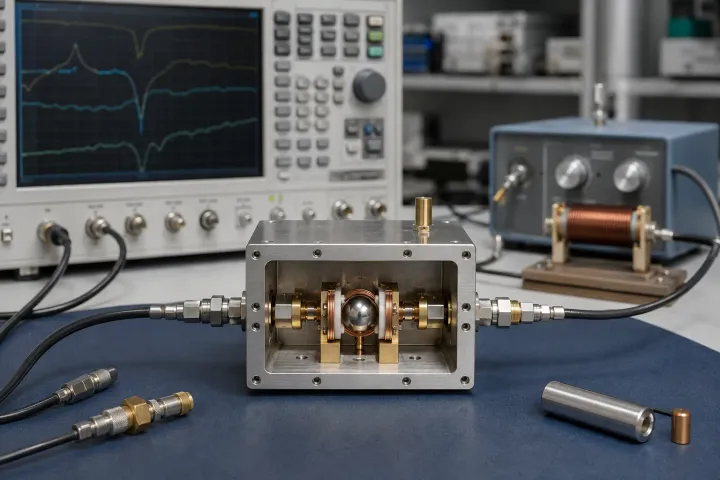
How single-crystal YIG sphere resonators set microwave Q factor and cutoff frequency: pure vs Ga-YIG 4πMs grades, ΔH linewidth, and BeO/sapphire rod alignment.
How YIG-tuned oscillators work: negative-resistance devices locked to magnetically tuned resonators, coil driver circuits, and dual-coil architecture.
Yttrium iron garnet resonates at a frequency set by an applied magnetic field, which is what makes octave-wide tunable oscillators and filters possible.
Compare YIG-tuned and cavity filters for RF preselection. When to choose octave-wide tunability versus fixed-frequency ultra-low insertion loss.
Parameters and testing
Stage-by-stage RF link budget calculator and RF calculation formula reference: EIRP, FSPL, kTB+NF noise floor, G/T, Eb/N0, and ITU-R P.838 X/Ku/Ka rain fade margins.
A practical check sheet for service calibration, internal alignment and the connected measurement chain.
Weight each log-spaced phase-noise row by its real hertz width, and keep the carrier, the limits, and the units with the sum.
Record stimulus, LO state, terminations, reference plane, and analyzer frequency before comparing an RF-to-IF isolation number a mixer datasheet left blank.
Where it is used
Map radar waveform timing, frequency coverage and noise offsets to LO, filter and converter checks, with explicit source-and-filter readiness conditions.
Buying and verifying
Check obsolete RF sourcing routes, custody records, inspection and RF testing, with contract-specific notification and suspect-counterfeit disposition boundaries.
Recently published
Compare Integer-N, Fractional-N Sigma-Delta, and Hybrid PLL+YIG RF frequency synthesizers across 20·log10(N) phase noise, PFD frequency, IBS spurs, and lock time.
RF transceiver module front-end isolation guide: TDD circulator, PIN switch, and limiter recovery time vs. FDD cavity duplexer TX-to-RX noise and carrier budgets.
RF module transmitter and receiver architecture guide: superheterodyne vs. Zero-IF signal chains, Friis cascaded noise figure, IIP3 linearity, and SFDR budgets.
An A/B fixture checklist and comparison matrix for a resistive pad, terminated diplexer, and absorptive filter when an IF filter adds mixer conversion-loss ripple.
Decide which mixer port swap a topology allows, then recheck passband, DC path, LO drive, isolation, conversion loss, and spurs on the datasheet.
What an asserted HMC832 lock detect confirms after a hop, which Register 0x07 fields change it, and how to record a separate RF frequency acceptance check.
Editorial disclosure
MicroSource Insights publishes engineering reference guides to RF, microwave, and YIG signal-chain components.